What Is RAG? How AI Chatbots Learn Your Business (in Plain English)
5 July 2026 · 5 min read
RAG (Retrieval-Augmented Generation) is a way of connecting an AI chatbot to your own documents, so it answers customers with your facts instead of guessing. It is the difference between a chatbot that embarrasses you and one that quietly does its job.
Why do chatbots make things up?
AI models like ChatGPT learned from the public internet. They know a lot about the world and almost nothing about your business. Ask a plain chatbot about your refund policy or your clinic's opening hours, and it does what AI does when it doesn't know: it guesses, fluently and confidently.
The industry calls this hallucination, and it is not a bug that will be patched next month. Producing plausible text is what these models are built to do. Ask one about your refund policy and it may invent a generous 30-day policy you never offered, in perfect, confident English. A customer who was quoted that policy will expect you to honour it. That is the risk RAG exists to remove.
How RAG fixes this
RAG adds one step before the AI answers: look it up first.
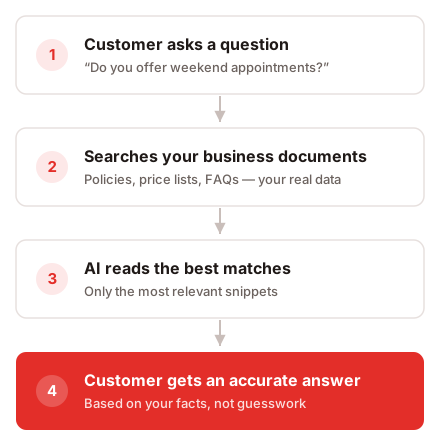
Instead of relying on memory, the chatbot searches your documents (price lists, policies, treatment FAQs, product specs), pulls out the most relevant passages, and writes its answer from those. The approach comes from a 2020 research paper out of Meta's AI lab [1] and has since become the standard way to build business chatbots [2].
What happens to your documents?
Nothing exotic. Your documents are split into small passages and stored in a searchable index, a bit like a very good filing clerk who has read everything once and remembers where every fact lives. When a customer asks a question, the system searches that index for the passages most related to the question, hands them to the AI model, and instructs it to answer from those passages and nothing else.
Your originals stay wherever they already live. The chatbot keeps a copy of the text, arranged for fast lookup. When you update the price list, we refresh the index, and from the next conversation onwards the old prices are gone. There is no retraining, which is why updating a RAG chatbot costs minutes rather than money.
What this means for your business
- The bot quotes your prices and your policies, not internet folklore.
- Update a document and the answers update with it. There is no retraining step, and no retraining bill.
- It works with private documents that were never on the public internet. Your data stays yours.
- Every answer is grounded in a source, so you can check where it came from.
What does RAG not fix?
We would rather set expectations now than surprise you after launch.
If a document is wrong, the bot will faithfully repeat the wrong thing. RAG makes a chatbot loyal to your documents, so the documents have to deserve that loyalty. Most projects start with a cleanup pass for exactly this reason, and owners are usually surprised by how many contradictions their own PDFs contain: two price lists, three versions of the cancellation policy, an FAQ from 2023.
If the answer is not in the documents at all, a well-built bot should say so and offer a human handover rather than improvise. We test for this deliberately before launch, asking questions the documents cannot answer and checking that the bot declines politely instead of guessing.
And RAG does not make the bot take actions. It answers. If you want it to book the appointment rather than describe how booking works, that is an AI agent, which is usually phase two of the same system.
How a project actually runs
A typical RAG chatbot build at SurgeStack goes like this. First we collect the documents: price lists, policies, FAQs, and the answers your staff already type into WhatsApp all day, which are often the best source of all. Then we build the index and the bot, and attack it with real customer questions, the misspelled, half-formed kind people actually send at 11pm. Launch is deliberately quiet: the bot goes onto the website or WhatsApp, and a human reviews its conversations daily for the first few weeks. After that, maintaining the bot mostly means maintaining the documents, which your own team can do without us.
Where we use it
Nearly every chatbot we build at SurgeStack has RAG under the hood, including the WhatsApp bot that answers a clinic's patients in English and Malay at any hour (the full case study). A clinic bot answering treatment questions at 2am is really RAG plus a friendly tone of voice. Same for a retail bot handling delivery and warranty questions, and for the voice agents that read the same documents aloud down the phone. If a chatbot needs to know your business, it needs RAG.
It travels well across languages, too. Malaysian customers write in English, Bahasa Melayu, and the rojak in between, often within a single message. The documents can stay in whichever language you keep them in, because the retrieval step finds the right passage and the model writes the reply in the language the customer used. Your receptionist has been doing this switch all day for years. Now the bot does it at 2am as well.
Want a chatbot that knows your business? Talk to us.
Sources
- Lewis et al. (2020). Retrieval-Augmented Generation for Knowledge-Intensive NLP Tasks. arXiv:2005.11401
- Gao et al. (2024). Retrieval-Augmented Generation for Large Language Models: A Survey. arXiv:2312.10997
FAQ
Do I need RAG if my business info is already on my website?
Yes. A generic chatbot might have seen your website, but it won't reliably use it. RAG guarantees the bot answers from your documents every time, and you control exactly which documents it reads.
What documents can a RAG chatbot use?
Almost anything: website pages, PDFs, price lists, policy documents, spreadsheets, and FAQs. If your team can read it, the chatbot can too.
How much does a RAG chatbot cost?
Less than most owners expect, because the AI model itself doesn't need retraining. At SurgeStack, chatbot projects typically range from RM 2,000 to RM 25,000 depending on scope.
Keep reading
Workflow Automation, Explained: What It Is and Why We Build on n8n
Workflow automation connects the apps you already use so routine work happens by itself. What it is, what to automate first, and why we build on n8n.
SEO After AI: How to Get Your Business Recommended by ChatGPT
AI assistants now answer the questions your customers used to Google. Here's how to make sure they mention your business: a plain-English intro to GEO.
How Large Language Models Work, Under the Hood (No Math Required)
A large language model predicts the next word, trillions of times. That one trick explains what AI is brilliant at and why it invents your prices.
Stay Ahead of the AI Curve
Weekly insights on AI trends, automation tips, and real-world case studies.